One agent. The whole investigation.
The Familiar investigates each alert end to end: evidence gathered, reasoning shown, response recommended. You speak plain English, and you approve anything consequential before it runs.
One front door. The whole SOC in plain English.
No query language to memorize, no flowchart to pre-build. You ask the way you would brief a senior analyst, and the Familiar investigates the evidence, shows you its reasoning, and carries it out across your tools once you approve.
It investigates before it acts. You approve before it casts.
Legacy consoles answer with rows and legacy SOAR makes you author every branch by hand. The Familiar answers with an investigation you can read: the evidence it found, what it recommends, and the tools it will touch. You approve, edit, or reject before a single action runs. Anything consequential stops again at the Seal.
- The investigation is visible: evidence, reasoning, and recommendation, before anything runs.
- You approve, edit, or reject the recommendation, so the Familiar never surprises you.
- Every consequential step stops at the Seal with a receipt attached.
Detection, response, and record-keeping, behind one ask.
The work a SOC has always done still happens. Signals are read and correlated, responses are planned and cast, and every decision is written down and kept in sync with your ticketing. The difference is that you no longer operate three surfaces to make it happen. The Familiar orchestrates all of it behind one conversation, and the reduced complexity is the point.
Reads and correlates the signals
Signals land from your tools, get correlated by entity into one timeline, and the Familiar names what is happening, mapped to MITRE ATT&CK, with the evidence kept attached.
Recommends and casts the Spell
Contain, evict, and restore across the tools you already run, mapped to MITRE D3FEND. Responses are reversible by design, and the consequential ones wait at the Seal.
Writes down every decision
The case documents itself as it unfolds: evidence, confidence, and approver on one replayable receipt, kept in sync with Jira, ServiceNow, or Resilient.
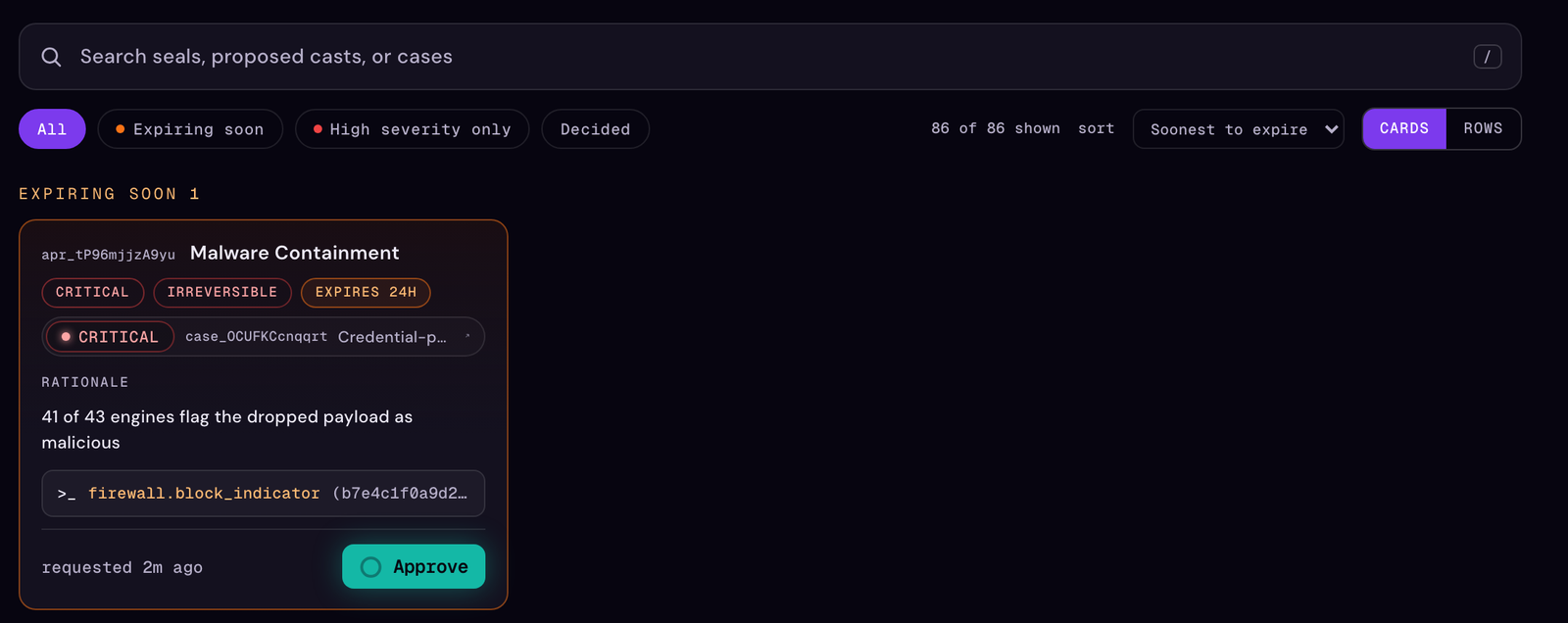
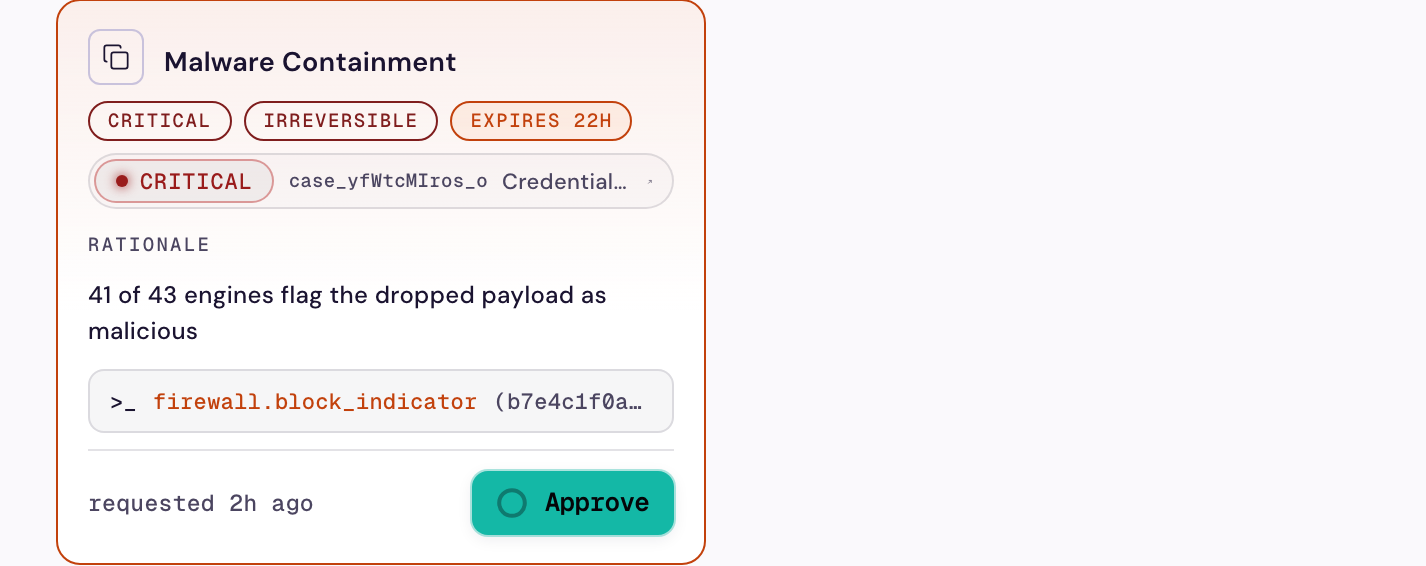
Actual product. Demo data.
Anything consequential stops at the Seal.
The Seal is a deterministic policy gate that lives outside the model. Reading, enriching, correlating, and drafting run on their own, where the risk is low. The moment a step is destructive or high-blast-radius, it halts with its rationale and a reversible plan, and a human makes the call. The model can plan and recommend anything; it cannot dispose on its own.
- Read, enrich, correlate, and draft: autonomous, where the blast radius is small.
- Anything consequential routes to the Seal for an explicit human approve or reject.
- Every decision carries a receipt: evidence, confidence, approver, and a full exportable audit.
Save what works. Adopt what others proved.
A Spell the Familiar builds does not evaporate when the case closes. It saves to your Spellbook to run again on demand, and the Bazaar lets you adopt prebuilt Spells for common outcomes instead of starting from a blank prompt.
Your Spellbook
Every Spell you build and approve is saved, versioned, and ready to run again. The plan-first, Seal-gated behavior comes with it, so a saved Spell is as safe to run as the first time you approved it.
The Bazaar
Adopt a prebuilt Spell for a common outcome: alert triage, phishing response, impossible-travel sign-ins. Read its plan, tune it to your stack, and it lands in your Spellbook.
Bring an alert. Watch it investigate.
A 30-minute walkthrough on your real triage flow. Bring an alert and watch the Familiar investigate, recommend, then stop at the Seal.